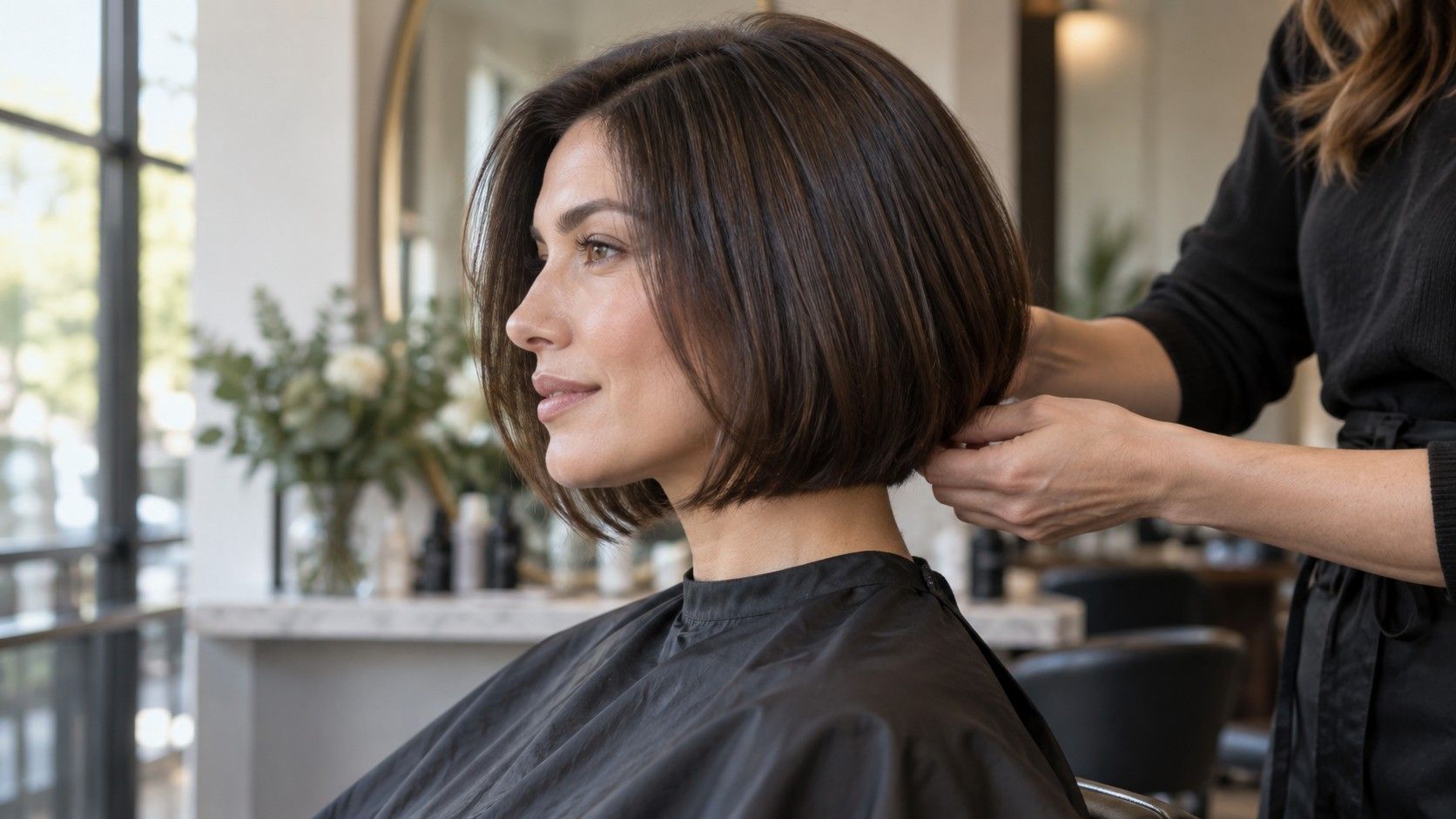
A bob is not one haircut with a few inches added or removed. Where it stops changes the balance of the jaw, the amount of neck on show, how the ends behave after a humid walk, and how quickly the cut starts to feel overdue. The useful question is less ‘Which bob is trending?’ than ‘Where can my hair stop without making my daily routine harder?’ A mirror, your usual parting, and an honest look at how your hair dries give better answers than a saved photograph alone.
Use facial landmarks, not a vague idea of short
Most bob haircut lengths are easier to compare when you name the stopping point. A lip-length or cheekbone bob sits high and deliberately graphic. A chin bob finishes near the point of the chin. A jaw bob often ends at the angle of the jaw, while a neck-length bob reaches the hollow below it. The long bob, usually called a lob, lands somewhere between the collarbone and the shoulders. Those labels sound precise, yet the same measurement looks different on two people because the neck, head shape, and posture are different.
Try the low-tech test before booking. Stand in front of a window with your hair tucked under at several heights, then take front, side, and three-quarter photos at eye level. Do it in the part you actually wear, not the centered part that appears only for the photo. A line that looks neat from the front can widen at the sides or rise unexpectedly at the back. If you wear glasses, put them on for the test: the ends of a short bob can line up with a frame corner and create a stronger horizontal line than expected.
There is also a practical landmark: the point where your hair bends when you turn your head. A blunt edge that catches there may flick out every morning, especially on fine hair with a slight bend. Moving the line half an inch above or below that point can make more difference than adding layers. That is why a good consultation involves the side profile and the nape, not only a face-framing sketch in the mirror.
Compare chin, jaw, and collarbone bobs before choosing
A chin-length bob has a clean, visible shape and can make the neck feel longer, but it is not automatically the easiest option. On hair that turns under naturally, the line can look polished with a quick blow-dry. On hair that expands at the sides, the same cut may form a triangle unless the weight is adjusted internally. A chin bob also puts the ends close to the mouth and jaw, so it makes the exact jawline more noticeable. That can be a feature if you like definition; it is worth considering if you prefer a softer outline.
A jaw-length bob is often the sharpest-looking version because it sits right at a strong facial landmark. It suits people who enjoy a crisp parting and are happy to style the front pieces. Its drawback is the grow-out stage: when the length moves past the jaw, it can sit at the widest part of the neck and lose its original intention for a few weeks. A slight forward angle, with the front only a little longer than the nape, can make that phase less awkward without turning the haircut into a dramatic stacked bob.
The collarbone lob gives the most room for a ponytail, a half-up style, and an unplanned no-heat day. It is usually the safer first bob for someone coming from long hair, though ‘safe’ should not mean shapeless. A blunt collarbone line can still look substantial; a few long face-framing pieces can stop it from feeling like an in-between cut. The trade-off is that it will not create the immediate exposed-neck effect of a French bob or a true chin bob.
| Stopping point | What it usually emphasizes | Daily reality to check |
|---|---|---|
| Cheekbone to lip | Eyes, cheekbones, and a visible neck | Needs frequent shaping and rarely ties back |
| Chin | A soft but definite outline around the face | Can turn outward at the jaw on bent texture |
| Jaw to upper neck | Strong structure and a graphic profile | Grow-out may sit at a difficult neck width |
| Collarbone lob | Movement, versatility, and a longer neck line | Needs a deliberate perimeter to avoid looking accidental |
Let texture decide how much length disappears
Length on wet hair is not length in real life. Loose waves can lift an inch or two after they dry; tight curls can change the apparent length much more. Ask the stylist to look at your hair dry, or at least to agree on where the finished shape should land after your normal drying routine. If you arrive with hair flat-ironed but usually wear it wavy, say so. The difference is not a minor styling preference when the entire haircut is measured around the jaw.
Fine straight hair often shows every line, which makes a blunt bob satisfying but unforgiving of an uneven cut. It may need a slightly softer edge or a hidden internal adjustment if the ends separate into stringy points. Dense straight hair can create a beautiful solid perimeter, yet too much bulk at the nape makes it kick outward. Wavy hair usually benefits from a shape that allows movement rather than forcing every strand into one level. A bob can have texture without being heavily layered; excessive short layers are a common reason a cut grows into a puff rather than a clean shape.
Cowlicks deserve a direct conversation. A front cowlick may split a fringe-like section and expose the forehead; a nape cowlick can push the back corner up. Neither makes a bob impossible, but both affect the safest length and part. Watch what the hair does when the stylist releases the clips before cutting the final outline. If it repeatedly opens in one place, that information matters more than a reference photo taken on someone with obedient hair.
Think about the parting and the back before committing
A center part gives a bob symmetry, but it can also expose uneven density or make a wide forehead feel more open. A deep side part creates volume and a softer sweep, but changes where the front corner lands. Bring your usual part to the appointment and ask to see the proposed line with it in place. Switching the part after the cut is not forbidden; it simply changes the weight distribution and can make one side seem longer.
The back is where many bob disappointments begin. A perfectly horizontal line may look heavier on a rounded head than on a flatter one. A slight graduation can keep the nape close without producing the stacked, helmet-like silhouette some people dislike. The right amount is often almost invisible from a normal distance. Ask for a side view in a hand mirror before the blowout hides the structure. You are checking whether the back follows the neck and whether the front is long enough to feel intentional when you look down or turn your head.
Be specific about your tolerance for styling. If you air-dry most weekdays, say that before someone designs a precise tucked-under shape that requires a round brush. If you love a flat iron, a jaw bob may be a pleasure rather than work. A haircut is not low maintenance merely because it is short; it is low maintenance when its natural movement resembles the result you want.
Plan the grow-out instead of treating it as a surprise
Hair usually grows around half an inch a month, but a bob can look different long before that. The first two or three weeks show the intended perimeter. By six to eight weeks, the nape and corners may be softening, especially if the cut sits above the jaw. That does not mean a trim is mandatory on a fixed calendar. It means you should decide whether you want to preserve the original architecture or let the cut travel toward a lob.
If you are nervous about short hair, choose a route rather than a single final image. Start at the collarbone, refine the perimeter once you know how it behaves, then move to the jaw on the next appointment if the shorter feeling still appeals. This staged approach costs time, but it avoids the common panic of cutting from mid-back to chin and discovering that you miss being able to gather the hair on a hot day. Conversely, someone who already knows they want a French bob should not leave with a cautious lob just because it is easier to reverse.
Maintenance includes the colour line as well. Highlights that looked blended on long hair may suddenly sit in obvious bands once the ends are removed. If you have bleach, old permanent dye, or a very dark base, discuss whether the haircut will expose a contrast you do not like. A bob often makes hair look healthier because damaged ends disappear, but it cannot erase a patchy colour history at the mid-lengths.
Bring useful information to the consultation
Bring two or three reference images with a note about what you like in each: the weight at the ends, the side profile, the length in front, or the texture. Do not expect one image to answer every question. It may show a beautiful jawline but conceal a highly styled nape, extensions, or a different density of hair. A good stylist can translate the ingredient you like into a cut that makes sense for your own hair.
Ask to agree on three details before cutting begins: the finished front length when dry, whether the back is blunt or gently graduated, and what will happen at your natural part. Then ask what styling tool the shape assumes. These are calm, ordinary questions, not a challenge to the stylist. The answer tells you whether the proposed bob fits your mornings.
The best bob cut length is the one that survives a rushed wash day and still makes sense in profile. A jawline bob can be striking, a chin bob can be soft, and a lob can be liberatingly flexible. None is universally flattering. Once you choose using real landmarks, texture, and grow-out plans, the stopping point becomes a practical decision rather than a gamble.