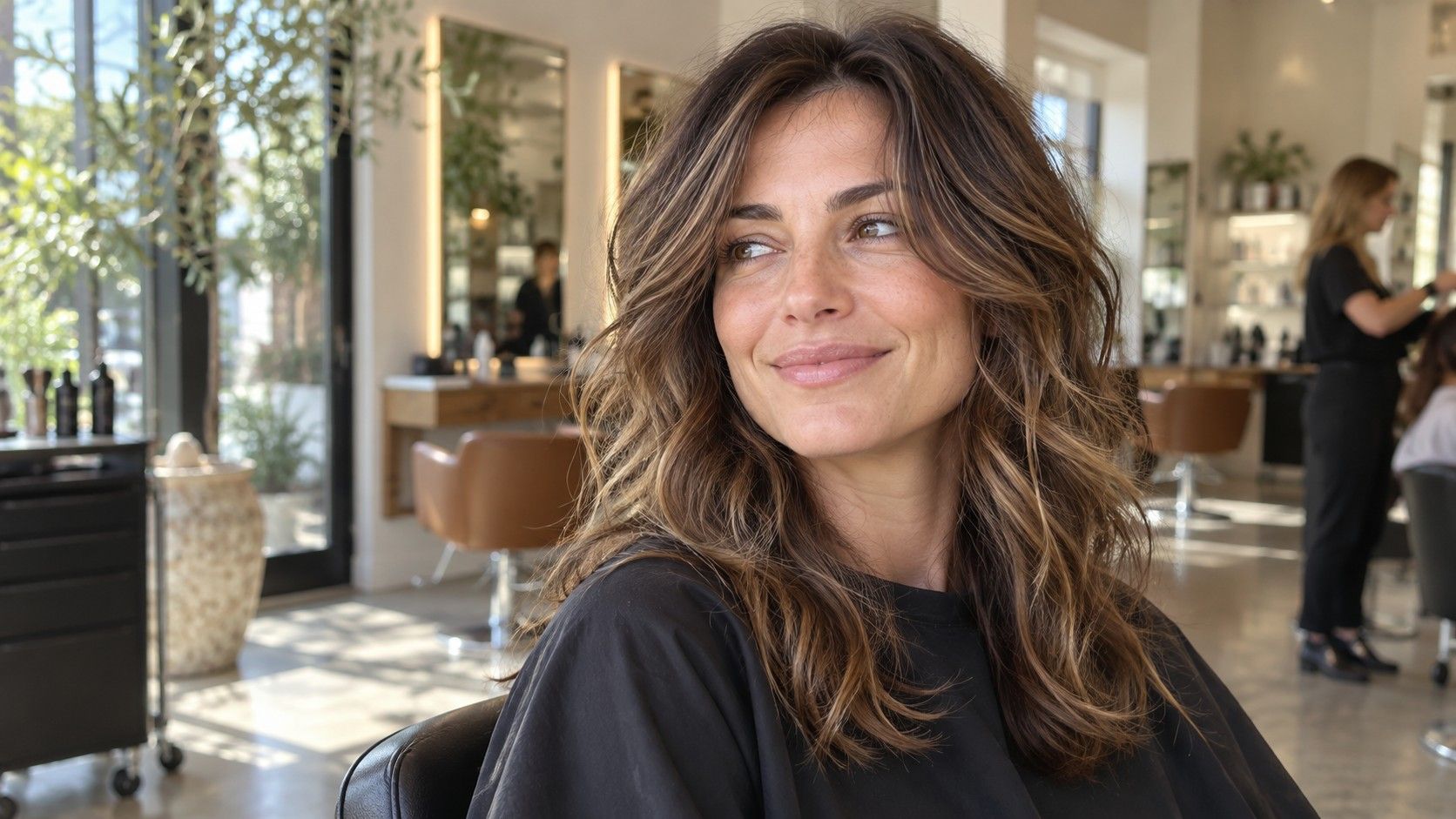
The best haircut for wavy hair is usually the one that still makes sense on the third morning after wash day, when the front pieces have changed their mind and there is no time for a full styling session. Waves are not merely straight hair with a bend added: they expand, contract, split into sections, and reveal every blunt or uneven decision made in the chair. Before collecting photos of hairstyles, look at your own pattern, density, and the amount of effort you will genuinely repeat each week.
Start the consultation with the wave you actually wear
A useful appointment begins before anyone reaches for scissors. Arrive with your hair close to its normal state, not freshly ironed and not stretched into a tight ponytail. A stylist needs to see where the bend starts: around the eye line, the jaw, or much lower through the lengths. That detail changes the best haircut more than a label such as 2A or 2C ever can.
Density matters just as much. Fine waves can look unexpectedly sparse if every layer is cut high and separated; dense waves can form a heavy triangular outline if nothing is removed from the interior. Ask the stylist to point out the thickest area and the place where your hair naturally parts. It is a small, concrete check, but it exposes whether the proposed shape is designed for your head rather than a saved photograph.
Bring two references: one close to your current length and texture, and one showing the amount of movement you want. A glossy studio picture with a curling iron finish is still useful for discussing silhouette, but it is poor evidence for daily behavior. The honest question is not “Can my hair look like this once?” but “What does this cut do after air-drying in a humid bathroom, then sleeping on it?”
Choose one-length or layers by weight, not by fashion
A one-length cut gives wavy hair a strong outer edge. On medium-density hair with a loose, even wave, that weight can make the ends look fuller and calmer. A collarbone-length blunt cut, for example, often gives 2A or soft 2B waves a tidy base without asking them to perform like curls. The trade-off is that the top can sit flat while the bottom gathers into a broad shape, especially if the hair is dense.
Layers solve a different problem: they release weight and let sections move independently. They are most convincing when the stylist places them around the places that already bend, rather than cutting a stack of identical short pieces. On thick hair, internal layers can stop the lower half from swelling outward. On fine hair, long, restrained layers may be enough; aggressive texturizing can turn the last four inches into a fuzzy, see-through edge.
| What you notice at home | Shape to discuss | Watch for |
|---|---|---|
| Ends look thin, top is fairly smooth | Mostly one length with long face framing | Too many short layers remove the weight that holds the wave together |
| Hair expands at the sides and feels heavy underneath | Long layers and targeted internal weight removal | Thinning shears near the crown can create frizz rather than control |
| Waves clump well but the outline feels boxy | Soft perimeter shaping around the jaw or collarbone | A hard shelf can make each clump end at the same awkward point |
| Front pieces lose their bend first | Longer face-framing layers that join the rest of the cut | Short disconnected pieces often need heat styling every morning |
The phrase “remove bulk” deserves a follow-up question. A razor, thinning shears, point cutting, and long internal layers all remove bulk in different ways. If your wave gets fluffy at the ends, ask exactly where the weight will be taken out and how that area will look when dry. The answer should be more specific than “it will feel lighter.”
Match the length to your shrinkage and your routine
Wavy hair shrinks, though usually less dramatically than a tight curl pattern. The surprise is often in a bob: a wet chin-length line may dry above the jaw, while the side sections spring up farther than the nape. If you are considering a long bob, decide the shortest dry point first. Then allow the wet cut to sit longer, particularly around the face where uneven shrinkage is most visible in a mirror.
A long bob works well when you want a clear outline and can tolerate some width near the cheeks. It is less forgiving if your waves switch from loose to pronounced across the head. A shoulder-length cut gives more room for the pattern to settle and for a quick low bun on difficult days. Longer hair can be easier to contain, but the length also pulls the wave down, so a person hoping for visible texture may need modest layers rather than another six inches of weight.
The shag has a different bargain. It can make wavy hair look lively because shorter crown layers encourage lift and separation, and its lived-in shape does not require a perfectly smooth finish. Yet a shag is not an automatic shortcut to volume. On very fine, low-density hair, too much crown layering can expose the scalp; on dense hair, it needs a deliberate perimeter so it does not become a rounded helmet. Ask to see where the shortest layer will land when dry, not only when it is lifted between fingers.
Have the wet-cut and dry-cut conversation early
Dry cutting is helpful when the goal is to refine an established wave pattern. The stylist can see a stubborn front clump, a side that springs higher, or an area that separates after a diffuser. It is particularly useful for small adjustments around bangs, a long bob perimeter, and face-framing layers. Dry cutting does not mean every wave needs a complete haircut without water; it means the final shape is checked in the state you recognize.
A wet cut can still be the sensible first pass, especially with very thick or long hair. It gives the stylist control over baseline length and allows clean sectioning. The caution is simple: wet hair hides shrinkage and exaggerates length. For a major change, agree on a conservative first cut, then reassess once the hair is dry and the wave has returned. Taking another half inch later is easy. Waiting for an over-short fringe to grow through an awkward stage is not.
If you diffuse, say so. Diffusing may lift the roots and tighten the pattern compared with air-drying, which affects how the crown and jawline sit. If you normally brush your hair before a shower but never between washes, mention that too. A cut designed around finger-coiled, high-definition clumps will not behave the same way on hair that gets a quick rake of cream and an air-dry.
Judge the haircut after the first wash, not under salon lights
Salon styling can make almost any shape look settled for an afternoon. The real test comes after you wash it with your usual cleanser, use your normal amount of product, and leave it alone long enough to dry. Take quick photos from the front, both sides, and back on day one and day three. You are looking for repeatable clues: whether the part falls back into place, whether the ends still look substantial, and whether one side suddenly creates a shelf.
Do not decide too quickly that every halo of frizz means a bad cut. New layers can make wave groups behave differently for a wash or two, and a change in length can expose product buildup or an overly heavy leave-in. But there are useful warning signs: a large empty gap under the crown, short pieces that only cooperate with a round brush, or a perimeter that appears stair-stepped when your hair dries naturally. Those are worth photographing and taking back for a minor correction.
A good refresh routine should support the cut rather than rescue it. A mist of water, a small amount of lightweight foam, and a few minutes with a diffuser can revive most wavy hairstyles without rebuilding every clump. If your new shape demands a full wash, heat styling, and several products just to avoid looking uneven, the problem may be the design rather than your technique. The most useful haircut leaves you with options: air-dry on a busy morning, diffuse when you want more definition, and still recognize your hair in both versions.
Use a short decision list before committing to the scissors
When choosing between the best haircut options for wavy hair, reduce the decision to a few practical facts. Do you want fuller ends or more movement at the crown? Does your hair become wider in damp weather? Are you prepared to style short face-framing pieces, or do you want them long enough to tuck behind an ear? These questions sound ordinary, but they prevent the common mismatch between a dramatic cut and a low-maintenance routine.
For many people, the safest first change is not a complete reinvention. Keep the overall length, add or adjust long layers, and make the perimeter intentional. Live with it through two wash cycles. If the hair feels heavy and flat, a later appointment can add more movement; if it already feels light, there is no need to chase the shag seen in a single video. Wavy hair rewards measured changes because its pattern supplies plenty of personality once the shape stops fighting it.